
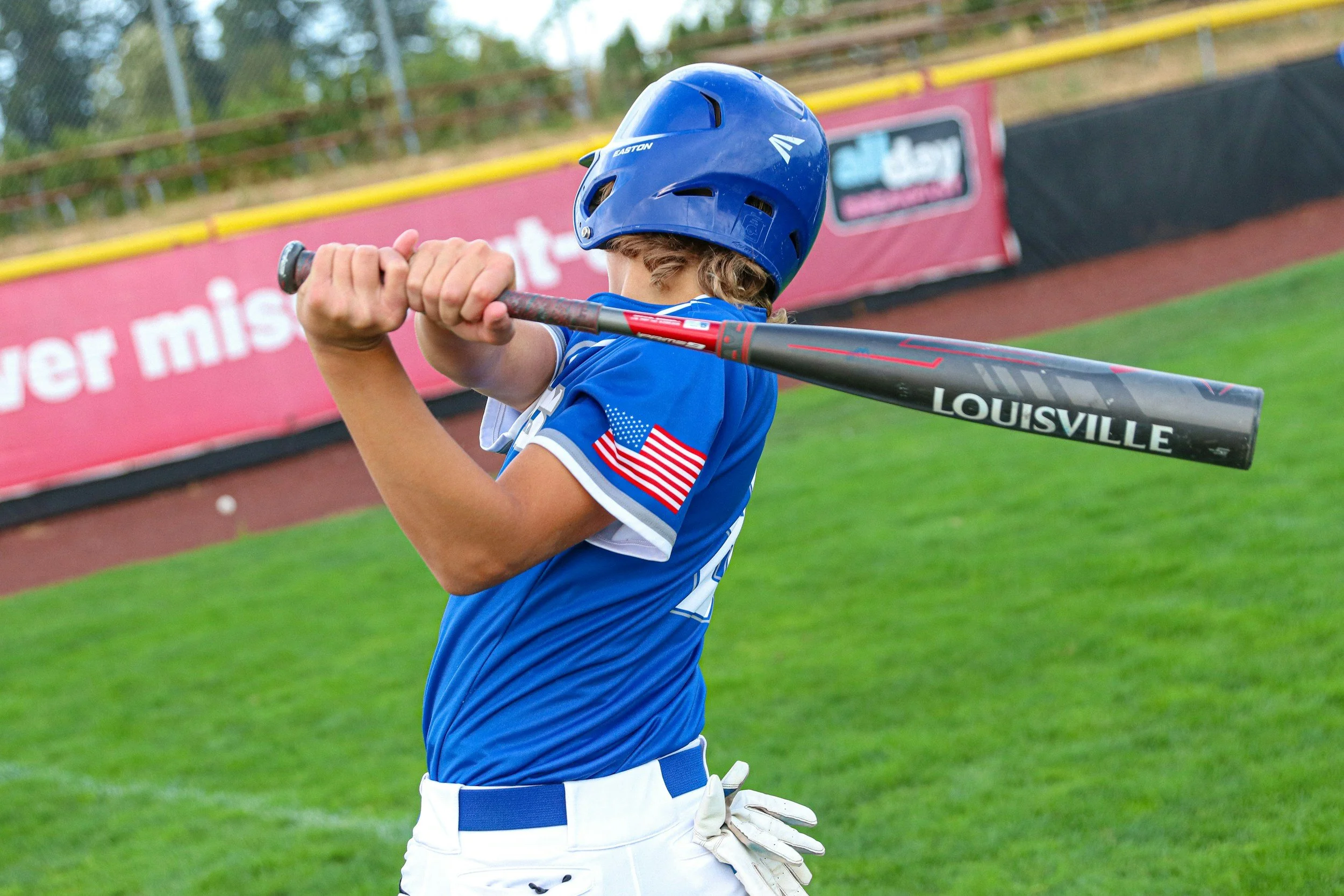
Baseball Hitting Development & Training
Baseball Hitting Training in Manassas, VA

WHAT BASEBALL HITTING DEMANDS
THE PITCH ARRIVES DOWNHILL.
The mound is ten inches high and the rubber sits 60 feet 6 inches away, so the pitch reaches your player traveling downhill at six to ten degrees. Their bat has to answer that plane.

EXIT VELOCITY ATTACK ANGLE BAT SPEED HITTRAX BLAST MOTION PITCH RECOGNITION SPRAY CHARTS
EXIT VELOCITY ATTACK ANGLE BAT SPEED HITTRAX BLAST MOTION PITCH RECOGNITION SPRAY CHARTS
OUR PROCESS
HOW IT WORKS
STEP 1
HITTRAX BASELINE
Week one we measure, film, and pick one thing to fix. Hitters given four corrections at once get worse, so every session after is measured against that baseline.
STEP 2
ONE FIX, UNDER PRESSURE
Week two works that change off the tee and on front toss. Week three puts it under pressure, machine velocity up and counts added, to see whether it survives a real fastball.
STEP 3
RETEST AND REVIEW
Week four is the retest against the week one baseline, side by side, with you there. Our hitters typically gain 3 to 5 MPH of exit velocity in those first four weeks.
HERE’S WHAT YOU GET
WHAT’S INCLUDED
► One-On-One Sessions
► HitTrax Baseline Session
► Blast Motion Metrics
► Attack Angle Correction
► Bat Path Work
► Exit Velocity Benchmarks
► Launch Angle Review
► Spray Chart Review
► Tee And Front Toss
► Machine Velocity Reps
► Win Reality Pitch Recognition
► Four-Week Baseline Retest

What Belongs Only to Baseball
Our hitting training program for baseball and softball covers the foundation both sports share. This page is about what belongs only to baseball: matching the bat to a descending pitch, reading numbers that mean different things at different ages, and turning cage work into at-bats that hold up in travel ball.
Attack Angle Matched to Pitch Plane
Attack angle is the up or down direction the bat is moving at contact. A pitch coming down at seven degrees is met best by a bat traveling up through the zone at a similar angle the other way, which gives your hitter the longest window where bat and ball can meet.
Most young hitters arrive with one of two problems. They have been told to swing down on the ball, which sends an already descending pitch into the ground, or they have overcorrected into an uppercut and hit the bottom of everything. Neither is a strength problem. Both are plane problems.
We put a Blast Motion sensor on the bat knob and read it directly: attack angle, bat speed, time to impact, on plane efficiency, peak hand speed, rotation. When a hitter moves from a negative attack angle into a positive one and holds their bat speed, ground balls turn into line drives.
What the HitTrax Numbers Actually Mean
Numbers only help when you know which ones matter at your player's age, so progress here is a chart rather than an opinion. Here is how we use HitTrax to track every swing.
For a 12-year-old
Off a tee, most 12-year-olds sit in the 50 to 60 MPH exit velocity range, and past 65 is real strength for that age. At 12 the top number is the least useful thing on the screen. We watch how many of twenty swings were hit hard, how tight the launch angle spread is, and whether the spray chart shows a hitter using the whole field. Chasing a personal best at 12 usually builds a swing they have to undo at 15.
What we watch session to session
Exit velocity, launch angle spread, and spray chart direction sit on the same screen as their Blast Motion numbers, so a change in bat path shows up right next to the result it produced. That is the difference between coaching a swing and guessing at one.
For a high school junior
Junior year is when college coaches start asking. Game exit velocity in the mid 80s puts a hitter in the discussion at most levels, and 90 and up gets attention fast. The number that travels is the average of their hardest eight swings, not one screenshot. A junior who touched 95 once and averages 78 is a different player from one who sits at 84, and the second one gets recruited.
Seeing the Pitch Is Half of Hitting It
A hitter who cannot recognize a slider out of the hand does not have a swing problem. We use Win Reality VR pitch recognition so your athlete gets decision reps against sequencing and velocity they would not face live for years, then carries a real two-strike approach into the cage.
How Sessions Run
Sessions are one hour and coach led, by owner and head coach Alonso Ruz Vera and Coach Raul Rodriguez. Athletes start at 8 and train through high school and travel ball. Bring a bat, glove, and cleats. We supply the rest, and parents are welcome to watch.
How often they should come
One session a week moves a hitter. Two is what most travel ball players do in the off season, in the weeks before tryouts. Whichever they come in on, the work stays one correction at a time, because that is the only way to know which change did the work.
We train at one facility, on Robertson Drive in Manassas. Families drive in from Gainesville, Haymarket, Centreville, and Ashburn. Start with baseball and softball training in Manassas, or see what training looks like for Gainesville families.
When you are ready, book a free evaluation and we will respond within 24 hours. You can also call or text 813-509-6955.
FREQUENTLY ASKED QUESTIONS
-
We start athletes at 8. At that age the work is bat path, balance, and repeatable contact, not exit velocity targets.
-
Most 12-year-olds fall between 50 and 60 MPH off a tee, and 65 or better is strong for the age. Hard contact rate matters more at 12 than the top number.
-
The general program covers the fundamentals both sports share. This one is built around a pitch that arrives downhill from 60 feet 6 inches, so attack angle, breaking ball recognition, and exit velo benchmarks are baseball specific.
-
One a week moves a hitter. Two is what most travel ball players do in the off season, before tryouts.
-
A bat, a glove, and cleats. We provide the rest. Parents are welcome to watch, and we walk you through the numbers at the end.
READY TO SEE THEIR NUMBERS?
START WITH A FREE EVALUATION
Bring your player in, we take a HitTrax baseline, and you leave knowing exactly what to work on first.
READY TO GET STARTED?
BOOK A FREE EVALUATION
Fill out the form, and the BTD team will be in touch to get you scheduled.